
NewsDetails
Wind Vibration Induced Failure of Power Line Iron Components
author:Dachuan time:2026-04-17 14:46:50 Click:108
Wind Vibration Induced Failure of Power Line Iron Components
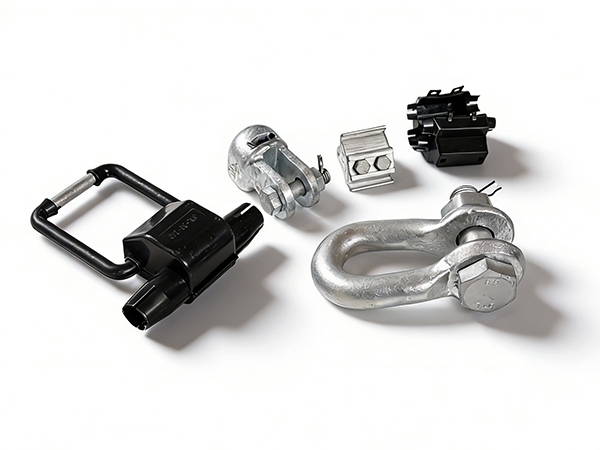
Power line iron components such as clamps, clevises, cross arms, bolts, connectors, and tension fittings are constantly exposed to wind-induced dynamic loads in overhead transmission and distribution systems. Even when wind speed is moderate, continuous airflow can generate complex vibration phenomena that lead to fatigue damage, loosening, and eventual structural failure of metal components.
1. Overview of Wind-Induced Vibration
Wind vibration refers to oscillatory motion of conductors and fittings caused by aerodynamic forces. It mainly includes:
Aeolian vibration (high frequency, low amplitude)
Galloping (low frequency, high amplitude)
Wake-induced oscillation
Subspan oscillation
These vibrations transfer dynamic stress to iron fittings and connection points.
2. Main Failure Mechanisms Caused by Wind Vibration
2.1 Fatigue Crack Initiation
Wind vibration produces repeated stress cycles in fittings.
Process:
Microcracks form at stress concentration points
Common locations: bolt holes, threads, edges, welded joints
Cracks gradually propagate under cyclic loading
2.2 Fatigue Fracture
Once cracks reach a critical size:
Sudden brittle or ductile fracture occurs
Failure often happens without visible deformation
Can lead to conductor drop or line interruption
2.3 Bolt and Fastener Loosening
Continuous vibration causes:
Loss of preload in bolts
Rotation or back-off of nuts
Reduction in clamping force
Result:
Joint instability
Increased wear and fretting damage
2.4 Fretting Wear Damage
Small relative movements between contact surfaces lead to:
Surface abrasion
Oxidation debris formation
Progressive material loss at interfaces
2.5 Structural Deformation
Long-term vibration can cause:
Permanent bending of clamps or brackets
Misalignment of cross arms
Loss of geometric stability
2.6 Corrosion Acceleration
Vibration damages protective coatings:
Zinc layer cracking or peeling
Exposure of bare steel
Accelerated rust formation
3. Key Factors Influencing Wind Vibration Damage
3.1 Wind Speed and Direction
Higher wind speed increases vibration amplitude
Changing wind direction induces complex oscillations
3.2 Span Length and Conductor Tension
Longer spans are more susceptible
Higher tension can increase vibration frequency
3.3 Structural Design of Fittings
Sharp edges increase stress concentration
Poor aerodynamic shapes amplify vortex shedding
3.4 Material Properties
Low fatigue resistance materials fail earlier
Brittle steels are more vulnerable to crack propagation
3.5 Installation Quality
Improper torque increases looseness risk
Misalignment enhances uneven stress distribution
4. Types of Wind Vibration Effects
4.1 Aeolian Vibration
High frequency, low amplitude oscillation
Causes long-term fatigue damage
4.2 Galloping
Low frequency, high amplitude motion
Often caused by ice or snow asymmetry on conductors
Highly destructive to fittings and insulators
4.3 Subspan Oscillation
Occurs in bundled conductors
Causes localized stress in connectors
5. Inspection and Monitoring Methods
5.1 Visual Inspection
Detect loosened bolts and abnormal movement
Identify coating damage or rust formation
5.2 Vibration Measurement
Accelerometers or vibration sensors
Measures amplitude and frequency of oscillation
5.3 Thermal Imaging
Detects friction heating at loose joints
Identifies abnormal stress regions
5.4 Non-Destructive Testing (NDT)
Magnetic particle testing for cracks
Ultrasonic testing for internal defects
5.5 Real-Time Structural Monitoring
Smart sensors embedded in fittings
Continuous monitoring of stress and vibration
6. Prevention and Control Measures
6.1 Vibration Dampers Installation
Stockbridge dampers for aeolian vibration
Spacer dampers for bundled conductors
Reduces vibration amplitude significantly
6.2 Structural Optimization
Improve aerodynamic shape of fittings
Reduce sharp edges and stress concentration zones
Use smooth transition designs
6.3 High-Fatigue-Resistance Materials
High-strength low-alloy (HSLA) steel
Forged components instead of cast parts
Improved heat treatment processes
6.4 Anti-Loosening Measures
Lock nuts and double-nut systems
Spring washers or locking plates
Thread-locking adhesives for critical joints
6.5 Corrosion Protection
Hot-dip galvanizing
Zinc-aluminum-magnesium coatings
Duplex protective systems
6.6 Installation Quality Control
Use calibrated torque tools
Ensure correct alignment of fittings
Standardize installation procedures
6.7 Line Design Optimization
Adjust span length and conductor tension
Avoid resonance frequency matching
Optimize tower and cross-arm configuration
7. Maintenance Strategies
Regular inspection of high-wind areas
Periodic tightening of bolts and connectors
Early replacement of fatigued components
Monitoring vibration-prone sections seasonally
8. Engineering Improvement Trends
AI-based wind vibration prediction systems
Smart damping devices with adaptive control
Digital twin simulation of dynamic line behavior
High-damping alloy materials
Self-monitoring fittings with embedded sensors
9. Conclusion
Wind vibration is one of the most critical dynamic loads affecting power line iron components. It leads to fatigue cracking, fastener loosening, fretting wear, structural deformation, and corrosion acceleration. Through vibration damping systems, improved structural design, high-performance materials, and strict maintenance practices, the harmful effects of wind-induced vibration can be effectively controlled, ensuring long-term stability and safety of transmission line systems.
References
IEC 60826 – Design criteria for overhead transmission lines
IEC 61284 – Overhead line fittings requirements and tests
IEEE 524 – Guide for installation of overhead line conductors
ASTM E466 – Fatigue testing of metallic materials
ASM Handbook – Fatigue and Vibration Failure Mechanisms
CIGRÉ Technical Brochures on Wind-Induced Vibration of Transmission Lines
 Recommended Products
 Contact us
—— Contact:Manager
—— Tel:+86 15631793633
—— Email:960244024@qq.com
—— Url:https://www.dachuan-power.com
—— Address:Liugusi Town, Hejian City, Cangzhou City, Hebei Province, China