
NewsDetails
Dimensional Deviation Problems of Custom Iron Fittings
author:Dachuan time:2026-04-17 14:43:36 Click:58
Dimensional Deviation Problems of Custom Iron Fittings
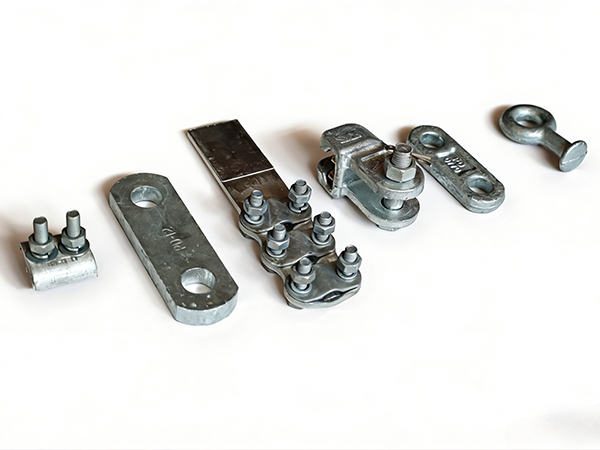
Custom iron fittings are widely used in power transmission lines, substations, and industrial steel structures. These components—such as clamps, connectors, brackets, clevises, and anchor parts—must meet strict dimensional accuracy requirements to ensure proper assembly, load transfer, and long-term structural reliability. However, dimensional deviation is a common manufacturing and field issue that can lead to installation difficulties, mechanical instability, and reduced service life.
1. Overview of Dimensional Deviation
Dimensional deviation refers to the difference between the actual manufactured size of a fitting and its design specification. It can occur in:
Length, width, and thickness
Hole spacing and diameter
Angular alignment
Thread dimensions
Assembly interface geometry
Even small deviations can affect fit-up accuracy and load distribution in power systems.
2. Main Types of Dimensional Deviation
2.1 Linear Dimensional Error
Incorrect overall length or width
Thickness deviation in forged or cast parts
Impact:
Poor assembly fit
Uneven load distribution
2.2 Hole Position Deviation
Misaligned bolt holes
Incorrect center-to-center spacing
Impact:
Installation difficulty
Stress concentration during forced assembly
2.3 Angular Deviation
Incorrect bending angle in brackets or connectors
Warping during manufacturing
Impact:
Misalignment of connected components
Reduced structural stability
2.4 Thread Dimension Deviation
Oversized or undersized threads
Poor thread pitch accuracy
Impact:
Loose or overly tight connections
Risk of stripping or slippage
2.5 Surface Flatness and Warping
Uneven surfaces after forging or welding
Thermal deformation during cooling
Impact:
Poor contact between mating parts
Reduced friction and stability
3. Causes of Dimensional Deviation
3.1 Manufacturing Process Errors
Inaccurate forging or casting molds
Improper machining parameters
Tool wear and poor calibration
3.2 Thermal Deformation
Uneven heating or cooling during forging
Residual stress release after heat treatment
Welding-induced distortion
3.3 Material Inconsistency
Uneven hardness distribution
Variable shrinkage during cooling
Poor-quality raw materials
3.4 Equipment Precision Issues
CNC machine calibration errors
Worn cutting tools
Fixture misalignment
3.5 Human Operational Errors
Incorrect setup parameters
Measurement mistakes
Improper quality control practices
3.6 Design-Related Issues
Overly complex geometry
Insufficient tolerance design
Lack of manufacturability consideration
4. Effects of Dimensional Deviation
4.1 Assembly Problems
Difficulty fitting components together
Need for forced installation
Increased installation time and cost
4.2 Structural Stress Concentration
Uneven load distribution
Localized overstress areas
Reduced fatigue life
4.3 Reduced Mechanical Performance
Lower connection strength
Increased risk of loosening or fracture
4.4 Safety Risks
Instability in power line structures
Potential component failure under load
Long-term operational hazards
5. Detection and Measurement Methods
5.1 Manual Measurement
Calipers, micrometers, and gauges
Suitable for basic dimensional checks
5.2 Coordinate Measuring Machine (CMM)
High-precision 3D measurement
Detects complex geometric deviations
5.3 Laser Scanning Technology
Non-contact measurement
Captures full surface geometry
5.4 Template and Go/No-Go Gauges
Quick inspection in mass production
Ensures interchangeability
5.5 Statistical Process Control (SPC)
Monitors production variation trends
Detects process drift early
6. Improvement Measures
6.1 Improve Manufacturing Accuracy
Use high-precision CNC machining
Upgrade forging and casting molds
Regular calibration of equipment
6.2 Optimize Tolerance Design
Define realistic and standardized tolerances
Avoid over-tight dimensional requirements
Consider manufacturing capability during design
6.3 Control Thermal Deformation
Improve heat treatment uniformity
Use controlled cooling processes
Reduce welding-induced stress
6.4 Strengthen Quality Inspection
90% inspection for critical dimensions
Use automated measurement systems
Implement batch sampling control
6.5 Improve Material Quality
Use stable and consistent raw materials
Control shrinkage behavior in casting processes
6.6 Standardize Production Processes
Strict process documentation
Operator training and certification
Real-time process monitoring systems
7. Preventive Design Strategies
Simplify structural geometry where possible
Design with assembly tolerance compatibility
Use modular standardized components
Apply finite element analysis (FEA) for deformation prediction
8. Common Industry Solutions
Precision forging instead of traditional casting
CNC finishing after heat treatment
Pre-assembly testing before shipment
Digital twin-based dimensional simulation
9. Future Development Trends
AI-based dimensional defect detection systems
Fully automated precision manufacturing lines
Real-time laser inspection during production
Smart feedback-controlled machining systems
High-stability alloy materials with low deformation rates
10. Conclusion
Dimensional deviation in custom iron fittings is a critical quality issue that affects assembly efficiency, mechanical performance, and structural safety in power systems. It is mainly caused by manufacturing inaccuracies, thermal deformation, equipment limitations, and design shortcomings. Through advanced machining technology, strict quality control, optimized tolerance design, and modern inspection systems, dimensional deviation can be effectively minimized, ensuring high precision and reliability of power line hardware components.
References
ISO 2768 – General tolerances for linear and angular dimensions
ISO 1101 – Geometrical product specifications (GPS)
ASTM E1444 – Magnetic particle inspection (quality control reference)
ASM Handbook – Manufacturing Processes and Dimensional Control
IEC 61284 – Overhead line fittings requirements and tests
CIGRÉ Technical Brochures on Power Line Hardware Manufacturing Quality and Precision Control
 Recommended Products
 Contact us
—— Contact:Manager
—— Tel:+86 15631793633
—— Email:960244024@qq.com
—— Url:https://www.dachuan-power.com
—— Address:Liugusi Town, Hejian City, Cangzhou City, Hebei Province, China