
NewsDetails
Compatibility Issues Between Iron Fittings and Insulators
author:Dachuan time:2026-04-17 14:44:35 Click:126
Compatibility Issues Between Iron Fittings and Insulators
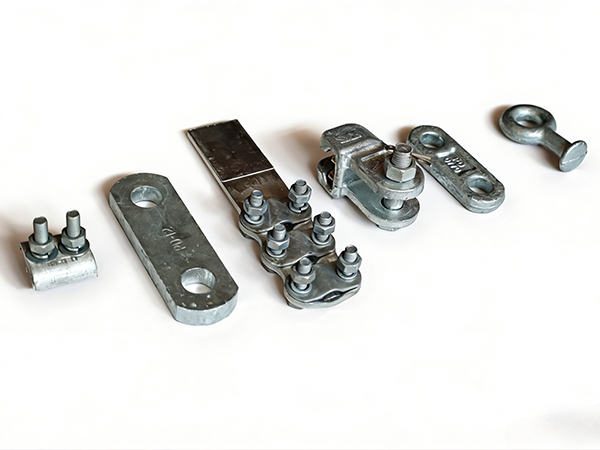
In overhead transmission and distribution systems, iron fittings and insulators must work together as a unified mechanical and electrical system. Iron fittings (such as clevises, yoke plates, sockets, and clamps) provide mechanical support, while insulators ensure electrical isolation. Compatibility between these two components is critical for safe load transfer, stable operation, and long service life. However, incompatibility issues are common in engineering practice and can lead to installation difficulties, mechanical failure, or even line outages.
1. Overview of Compatibility in Power Line Systems
Compatibility refers to the ability of iron fittings and insulators to:
Fit together mechanically without stress or deformation
Transfer mechanical loads safely
Maintain proper electrical clearance
Meet standardized interface requirements
Ensure long-term operational stability
Poor compatibility can compromise both mechanical integrity and insulation performance.
2. Main Types of Compatibility Issues
2.1 Dimensional Mismatch
Incorrect pin diameter or socket size
Inconsistent clevis or tongue dimensions
Non-standard hole spacing
Impact:
Forced installation
Stress concentration at connection points
Reduced structural reliability
2.2 Mechanical Strength Mismatch
Fitting strength higher or lower than insulator rating
Uneven load distribution between components
Overloading of fragile insulator parts
Impact:
Insulator cracking or breakage
Premature fatigue failure of fittings
2.3 Interface Design Incompatibility
Different manufacturer standards
Non-matching coupling structures (ball-socket, tongue-clevis, etc.)
Inconsistent geometric tolerances
Impact:
Assembly difficulty
Misalignment of load path
Increased installation time
2.4 Electrical Clearance Issues
Insufficient spacing between conductive fittings
Incorrect insulator string configuration
Sharp edges increasing corona risk
Impact:
Partial discharge
Flashover risk under high voltage
Reduced insulation reliability
2.5 Material Compatibility Problems
Different thermal expansion rates
Corrosion interaction between dissimilar metals
Coating incompatibility affecting contact surfaces
Impact:
Loosening under temperature variation
Galvanic corrosion
Reduced service life
2.6 Coating and Surface Treatment Mismatch
Uneven galvanizing thickness
Poor coating adhesion between mating parts
Friction changes affecting joint stability
Impact:
Slippage at connection points
Accelerated corrosion at interfaces
3. Root Causes of Compatibility Problems
3.1 Lack of Standardization
Different manufacturers use different interface dimensions
Regional standards not fully unified globally
3.2 Design Oversight
Insufficient coordination between insulator and fitting design teams
Ignoring assembly tolerances during design stage
3.3 Manufacturing Variability
Dimensional deviation in forging or casting
Inconsistent machining accuracy
3.4 Improper Material Selection
Mixing materials with different mechanical properties
Ignoring environmental adaptation requirements
3.5 Installation Errors
Use of non-matching components in the field
Incorrect assembly sequence or torque control
4. Effects of Incompatibility
4.1 Mechanical Failure
Insulator fracture
Fitting deformation or cracking
Joint slippage under load
4.2 Electrical Performance Degradation
Reduced insulation distance
Increased risk of flashover
Corona discharge at connection points
4.3 Installation Difficulties
Forced assembly causing stress damage
Increased labor time and cost
4.4 Reduced System Reliability
Accelerated wear of components
Shortened service life of transmission line hardware
5. Inspection and Evaluation Methods
5.1 Dimensional Compatibility Inspection
Caliper and gauge measurement
Verification against standard drawings
5.2 Trial Assembly Testing
Pre-installation dry fit tests
Ensures mechanical fit before field use
5.3 Load Testing
Mechanical tensile tests of assembled units
Verifies strength matching between components
5.4 Electrical Testing
High-voltage insulation testing
Partial discharge and corona detection
5.5 Finite Element Analysis (FEA)
Simulates stress distribution at interfaces
Identifies weak compatibility points
6. Solutions to Compatibility Issues
6.1 Standardization of Interfaces
Adopt IEC/IEEE standardized connection geometries
Use universal clevis-socket or ball-socket systems
Harmonize dimensional tolerances across manufacturers
6.2 Improved Design Coordination
Integrated design between insulator and fitting manufacturers
Early-stage compatibility simulation
Modular design approach
6.3 Material Matching Optimization
Select materials with similar thermal expansion coefficients
Avoid dissimilar metal contact without insulation
Improve corrosion compatibility
6.4 Precision Manufacturing Control
CNC machining for critical dimensions
Strict tolerance control systems
Automated inspection during production
6.5 Surface and Coating Optimization
Consistent hot-dip galvanizing thickness
Anti-corrosion coating compatibility testing
Use of insulating pads or liners where needed
6.6 Field Installation Control
Strict component matching before installation
Use of standardized kits instead of mixed parts
Training for installation personnel
7. Preventive Engineering Strategies
Design-for-assembly (DFA) principles
Unified global standard adoption
Digital twin simulation for system compatibility
Interchangeability testing across suppliers
Smart labeling and traceability systems
8. Future Development Trends
Fully standardized global power hardware systems
Smart self-identifying compatible components (RFID-based)
AI-assisted design for compatibility prediction
High-precision modular connection systems
Advanced composite insulator-fittings integration
9. Conclusion
Compatibility issues between iron fittings and insulators are mainly caused by dimensional mismatch, strength imbalance, interface inconsistency, and material differences. These problems can lead to mechanical failure, electrical hazards, and reduced system reliability. Through strict standardization, precision manufacturing, coordinated design, and comprehensive testing, compatibility can be significantly improved, ensuring safe and efficient operation of overhead power transmission systems.
References
IEC 60120 – Ball and socket couplings of string insulator units
IEC 60383 – Insulators for overhead lines
IEC 61284 – Overhead line fittings requirements and tests
IEEE 987 – Guide for insulator and hardware coordination
ISO 1461 – Hot-dip galvanized coatings on steel hardware
CIGRÉ Technical Brochures on Insulator String Systems and Hardware Compatibility
 Recommended Products
 Contact us
—— Contact:Manager
—— Tel:+86 15631793633
—— Email:960244024@qq.com
—— Url:https://www.dachuan-power.com
—— Address:Liugusi Town, Hejian City, Cangzhou City, Hebei Province, China