
NewsDetails
Common Defects in Casting & Forging Power Fittings
author:Dachuan time:2026-04-17 16:51:12 Click:74
Common Defects in Casting & Forging Power Fittings
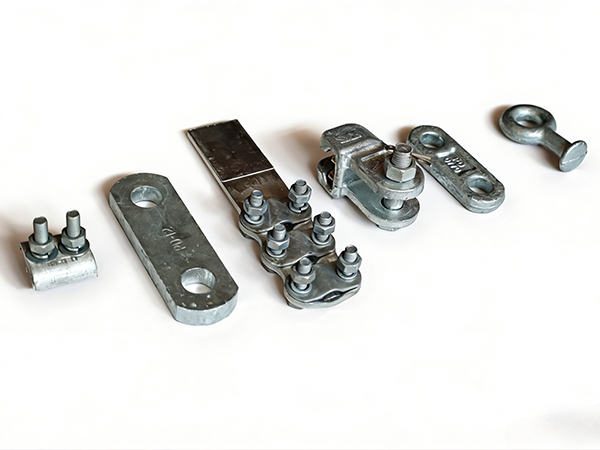
Casting and forging are the two primary manufacturing processes used for power fittings such as clamps, connectors, clevises, shackles, and other line hardware. These components must withstand high mechanical loads, environmental stress, and long service cycles. However, defects introduced during manufacturing can significantly reduce performance, leading to premature failure in overhead transmission systems.
1. Common Defects in Casting Power Fittings
1.1 Porosity (Gas or Shrinkage Voids)
Porosity is one of the most frequent casting defects. Gas trapped during solidification or improper cooling can create internal voids, reducing the effective load-bearing area and weakening structural integrity.
1.2 Shrinkage Cavities
These occur when molten metal contracts during cooling without sufficient feeding. Shrinkage cavities typically form in thick sections and act as crack initiation points under stress.
1.3 Inclusions
Non-metallic materials such as slag, sand, or oxide particles may become trapped in the casting. These inclusions reduce mechanical strength and create stress concentration zones.
1.4 Surface Roughness and Cold Shuts
Incomplete metal flow or premature solidification leads to poor surface finish or weak bonding between metal streams, resulting in cold shuts that can propagate cracks.
1.5 Hot Cracks
Formed during solidification when thermal stress exceeds material strength. These cracks often appear at corners or junctions where stress concentration is high.
2. Common Defects in Forging Power Fittings
2.1 Forging Cracks
Cracks may occur due to excessive deformation, low forging temperature, or poor material ductility. These cracks can propagate under cyclic loading.
2.2 Under-Forging (Incomplete Filling)
When the metal does not fully fill the die cavity, it results in missing sections or insufficient material density, weakening the component.
2.3 Over-Forging and Fiber Disruption
Excessive deformation can break the metal’s natural grain flow (fiber structure), reducing fatigue resistance and mechanical strength.
2.4 Laps and Folds
Surface layers fold over during forging but do not fuse properly, creating weak points that may open under stress or corrosion.
2.5 Scale Impressions
Oxide scale trapped between die surfaces and metal leads to surface defects and weak bonding areas.
3. Causes of Manufacturing Defects
3.1 Improper Process Control
Inaccurate temperature control during casting or forging is a major cause of cracks, porosity, and incomplete forming.
3.2 Poor Material Quality
Impurities or inconsistent alloy composition increase the likelihood of inclusions and structural weakness.
3.3 Mold or Die Defects
Worn-out or poorly designed molds/dies can cause uneven metal flow, surface defects, and dimensional inaccuracies.
3.4 Inadequate Cooling Control
Uneven cooling rates lead to internal stress, shrinkage defects, and cracking.
3.5 Operator Errors
Incorrect handling, insufficient lubrication, or improper forging sequences can introduce defects during production.
4. Effects of Casting and Forging Defects
Reduced Mechanical Strength: Lower load-bearing capacity under tension
Fatigue Failure: Defects act as crack initiation points under vibration
Corrosion Acceleration: Porosity and surface defects trap moisture
Dimensional Inaccuracy: Poor fit with conductors or other fittings
Sudden Fracture Risk: Hidden internal defects may lead to unexpected failure
5. Detection and Quality Inspection Methods
5.1 Visual Inspection
Used to identify surface cracks, folds, and visible porosity.
5.2 Ultrasonic Testing (UT)
Detects internal voids, inclusions, and hidden cracks.
5.3 Magnetic Particle Testing (MT)
Effective for identifying surface and near-surface cracks in ferromagnetic materials.
5.4 Radiographic Testing (RT)
X-ray inspection reveals internal casting defects such as shrinkage cavities and gas porosity.
5.5 Metallographic Analysis
Examines grain structure and identifies forging quality issues such as fiber discontinuity.
6. Prevention and Improvement Measures
6.1 Strict Process Control
Maintain precise temperature control during melting, casting, and forging to ensure material integrity.
6.2 High-Quality Raw Materials
Use clean, standardized alloys with controlled impurity levels.
6.3 Mold and Die Optimization
Regular maintenance and optimization of molds and forging dies improve metal flow and reduce defects.
6.4 Controlled Cooling Processes
Implement uniform and controlled cooling to reduce internal stress and shrinkage issues.
6.5 Proper Forging Ratio Design
Ensure adequate deformation ratios to achieve dense grain structure and improved fatigue resistance.
6.6 Non-Destructive Testing (NDT)
Perform routine inspections on all batches before deployment to ensure reliability.
6.7 Operator Training and Standardization
Improve manufacturing consistency through standardized operating procedures and training programs.
7. Field Implications of Defective Components
Early fracture of clamps or connectors under load
Unexpected conductor drop due to fitting failure
Accelerated corrosion at defect locations
Increased maintenance and replacement frequency
Risk of system outages in critical transmission lines
Conclusion
Casting and forging defects in power fittings are critical quality concerns that directly affect mechanical strength, fatigue resistance, and long-term reliability. Most defects originate from poor process control, material issues, or tooling imperfections. Through strict manufacturing control, advanced inspection techniques, and proper material selection, these defects can be significantly reduced, ensuring safe and durable performance in power transmission systems.
References
ASTM A703/A703M – Standard Specification for Steel Castings
ISO 4967 – Steel – Determination of non-metallic inclusions
IEC 61284: Overhead lines – Requirements and tests for fittings
CIGRÉ Technical Brochures on Manufacturing Quality of Line Hardware
ASM Handbook, Volume 15 – Casting and Forging Processes
 Recommended Products
 Contact us
—— Contact:Manager
—— Tel:+86 15631793633
—— Email:960244024@qq.com
—— Url:https://www.dachuan-power.com
—— Address:Liugusi Town, Hejian City, Cangzhou City, Hebei Province, China