
NewsDetails
Adjustable Pole Hardware for Field Installation and Line Upgrading
author:Dachuan time:2026-07-22 21:23:47 Click:65
Not every overhead line is built from scratch on a perfectly planned route with ideal conditions. Distribution networks evolve over decades — conductors are uprated, poles are relocated, equipment is added or replaced, and terrain subsides or shifts beneath structures. In all these situations, field crews need hardware that can accommodate real-world variability without requiring bespoke fabrication. Adjustable pole hardware — including variable-reach clamps, angular adjustment brackets, telescoping assemblies, and field-bendable fittings — fills this need by providing the flexibility to make modifications without redesigning the entire structure. This article examines the types, applications, and specification considerations for adjustable pole hardware in utility construction and maintenance.
Why Adjustability Matters in Field Conditions
In a new construction project, the structural designer controls every parameter — pole position, height, lean, cross arm orientation, and equipment placement. In a modification or upgrade scenario, the field crew works with existing structures that deviate from original specifications in ways that may not have been anticipated in the original design. A pole that has developed lean since installation, a cross arm that has rotated slightly due to unbalanced conductor loading, or a equipment mounting position that needs to shift to accommodate a new conductor configuration — these are common situations that require hardware with some degree of field adjustability.
The alternative to adjustable hardware is custom fabrication or field modification — both of which introduce delays, cost increases, and quality risks. Adjustable hardware allows the crew to resolve these issues with catalog products installed using standard procedures, maintaining schedule and quality.
Types of Adjustable Clamps and Brackets
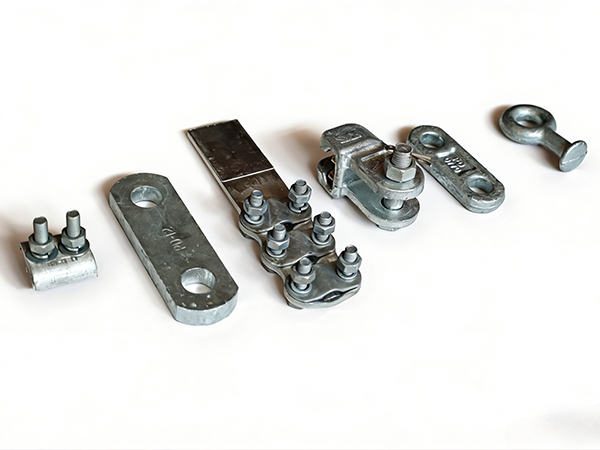
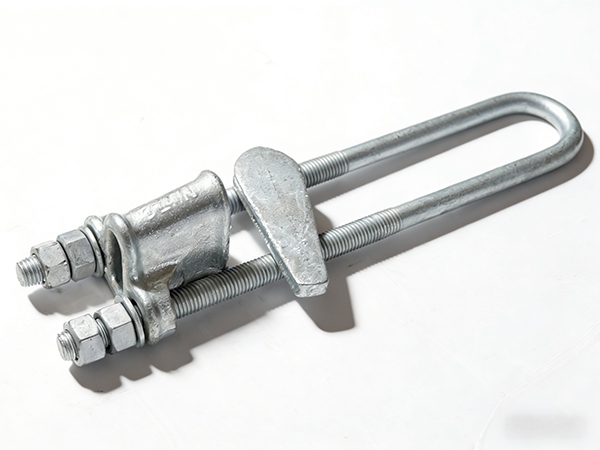
The most common adjustable hardware category is the adjustable pole clamp. These clamps use a sliding or pivoting mechanism — typically secured by one or more nuts on a threaded rod — that allows the clamp width or reach to be set to the actual pole dimensions encountered in the field. Adjustable clamps are available in several designs: band-type clamps with a turnbuckle or adjustment screw for fine-tuning the band tension, bolt-through clamps with elongated holes that allow limited positional adjustment of the bolt pattern, and bracket assemblies with pivoting heads that allow angular adjustment of the mounted equipment.
Angular adjustment brackets are another widely used category. These brackets have a hinge or pivoting joint that allows the mounting angle of the supported equipment — typically insulators or cable supports — to be set within a defined range during installation. This capability is valuable when the actual pole lean or cross arm orientation differs slightly from the planned configuration.
Field-Bendable Angle Iron Assemblies
For more significant adjustments, field-bendable angle iron assemblies allow a limited amount of bending at designated points to accommodate unusual pole configurations. These assemblies are pre-notched or scored at the bend locations to control the bend radius and prevent stress concentrations that could lead to cracking or failure. Field bending should be performed according to the manufacturer's instructions, and the bent section should be inspected for surface cracks before installation.
Material and Strength Considerations
Adjustable hardware must maintain structural integrity comparable to fixed hardware despite the introduction of articulation points, elongated bolt holes, or other adjustability features that could reduce load capacity compared to a solid fixed design. Engineers specifying adjustable hardware should verify that the rated load of the adjustable assembly meets or exceeds the design load for the specific application, rather than assuming that an adjustable version of a fixed design has the same load rating.
Corrosion Protection for Adjustable Hardware
Articulation points and threaded adjustment mechanisms are particularly vulnerable to corrosion because they create gaps and crevices where moisture can accumulate and because the movement associated with adjustment can damage protective coatings at contact surfaces. Hot-dip galvanizing is the preferred coating for adjustable hardware, with additional consideration given to the use of stainless steel or brass hardware at critical articulation points where repeated movement is expected during installation.
Conclusion
Adjustable pole hardware provides the flexibility that field crews need to handle the real-world variability of existing overhead line infrastructure. Selecting products with adequate load ratings, appropriate adjustability ranges, and robust corrosion protection — and ensuring that field personnel are trained in correct installation procedures — allows utilities to perform upgrades and modifications efficiently without compromising structural integrity.
References
IEC 61284 — Overhead Line Fittings — Requirements and Tests
IEEE NESC C2 — National Electrical Safety Code
ASTM A123 — Standard Specification for Zinc (Hot-Dip Galvanized) Coatings on Iron and Steel Products
ISO 1461 — Hot Dip Galvanized Coatings on Fabricated Iron and Steel Articles
We warmly welcome global distributors to partner with us — together we can deliver reliable power line hardware solutions to markets worldwide.
 Recommended Products
 Contact us
—— Contact:Manager
—— Tel:+86 15631793633
—— Email:960244024@qq.com
—— Url:https://www.dachuan-power.com
—— Address:Liugusi Town, Hejian City, Cangzhou City, Hebei Province, China