
NewsDetails
Application of Hoop & Clamp Components in Distribution Network Construction
author:Dachuan time:2026-04-17 11:22:33 Click:107
Application of Hoop & Clamp Components in Distribution Network Construction
Hoop and clamp components are widely used fastening and support elements in overhead distribution networks. They are primarily applied to secure cross arms, insulators, cables, and auxiliary hardware to utility poles, ensuring structural stability and reliable electrical performance. Due to their simplicity, versatility, and cost-effectiveness, hoops and clamps are indispensable in modern distribution line construction.
1. Overview of Hoop & Clamp Components
Hoops (also known as pole bands or pole hoops) are circular or semi-circular metal bands designed to wrap around utility poles. Clamps are mechanical fastening devices used to grip and secure conductors, cables, or hardware.
Typical materials include:
Carbon steel (galvanized for corrosion resistance)
Stainless steel (for harsh environments)
Aluminum alloys (for lightweight applications)
These components are commonly treated with hot-dip galvanizing to ensure long-term durability.
2. Types of Hoop & Clamp Components
2.1 Pole Hoops (Pole Bands)
Wrap around concrete, wooden, or steel poles
Provide attachment points for cross arms and brackets
Available in full-circle or half-circle designs
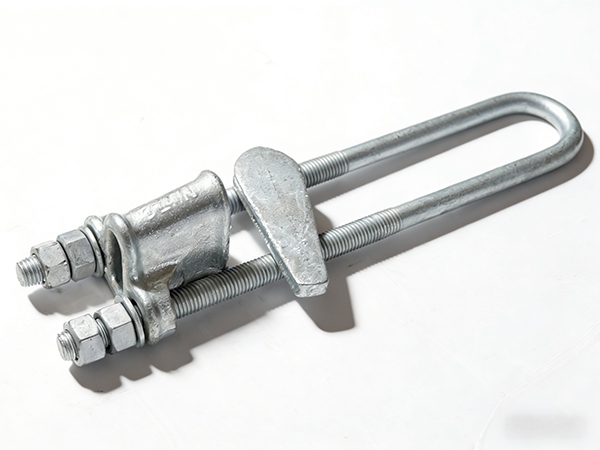
2.2 U-Clamps and U-Bolts
Used to secure cables, pipes, or small hardware
Provide strong clamping force
Adjustable and easy to install
2.3 Suspension Clamps
Support conductors in straight-line sections
Allow limited movement to reduce mechanical stress
Common in low- and medium-voltage distribution lines
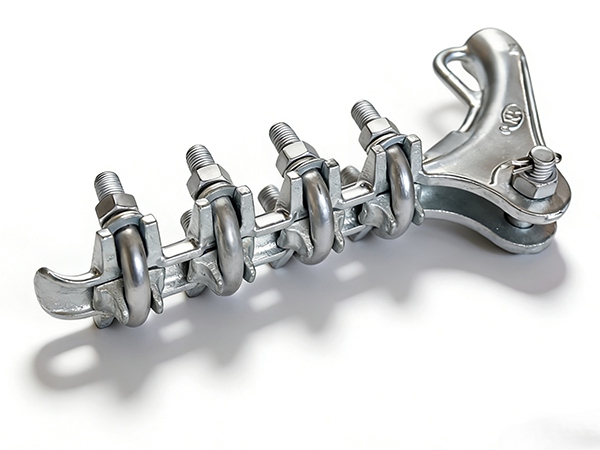
2.4 Tension Clamps (Dead-End Clamps)
Anchor conductors at line ends or angle نقاط
Withstand high tensile forces
Ensure conductor stability under tension
2.5 Cable Clamps and Accessories
Secure insulated cables or bundled conductors
Prevent sagging and vibration
Often used in aerial bundled cable (ABC) systems
3. Functional Roles in Distribution Networks
3.1 Structural Support
Hoops and clamps provide essential support by:
Fixing cross arms and brackets to poles
Securing insulator assemblies
Maintaining alignment of conductors
3.2 Load Transfer
Distribute mechanical loads from conductors to poles
Ensure stable load paths under wind, tension, and environmental forces
3.3 Positioning and Stability
Maintain correct spacing and positioning of cables and hardware
Prevent movement or displacement during operation
3.4 Vibration Control
Reduce conductor movement caused by wind
Work in conjunction with dampers to minimize fatigue damage
4. Design Considerations
4.1 Mechanical Strength
Must withstand tensile, shear, and compressive forces
Designed with appropriate safety factors
Critical for long-term structural integrity
4.2 Corrosion Resistance
Hot-dip galvanizing is standard for outdoor applications
Stainless steel is preferred in coastal or highly corrosive environments
Coating thickness must meet relevant standards
4.3 Compatibility
Must match pole diameter, conductor size, and hardware dimensions
Standardized designs ensure interchangeability
4.4 Ease of Installation
Simple structure allows quick installation
Adjustable designs accommodate different pole sizes
Reduces labor time and installation cost
5. Installation Practices
5.1 Pole Hoop Installation
Position at specified height and orientation
Ensure tight fit around the pole
Use appropriate fasteners and torque values
5.2 Clamp Installation
Ensure proper alignment with conductors or hardware
Avoid over-tightening to prevent damage
Use locking devices to prevent loosening
5.3 Safety Measures
Follow safety procedures during installation
Use insulated tools when working near energized خطوط
Ensure proper grounding where required
6. Performance in Service
6.1 Load-Bearing Reliability
Maintain structural integrity under continuous and peak loads
Resist deformation and loosening over time
6.2 Environmental Durability
Withstand exposure to moisture, UV radiation, and pollutants
Maintain corrosion resistance over long service periods
6.3 Maintenance Requirements
Periodic inspection for corrosion, loosening, or damage
Re-tightening or replacement as necessary
Minimal maintenance when properly installed and protected
7. Advantages of Hoop & Clamp Components
Simple and cost-effective design
Easy installation and replacement
High adaptability to various pole types and configurations
Reliable performance under diverse environmental conditions
8. Limitations and Challenges
Potential for corrosion if coating is damaged
Improper installation may lead to loosening
Limited load capacity compared to heavy-duty structural fittings
9. Conclusion
Hoop and clamp components play a fundamental role in the construction and operation of distribution networks. Their ability to securely fasten and support key elements ensures the stability and reliability of overhead lines. By selecting appropriate materials, ensuring proper installation, and maintaining regular inspection, these components can provide long-lasting and efficient performance in a wide range of operating environments.
References
IEC 61284 – Overhead lines – Requirements and tests for fittings
ASTM A153/A153M – Zinc Coating (Hot-Dip) on Iron and Steel Hardware
ISO 1461 – Hot-dip galvanized coatings on fabricated iron and steel articles
IEEE Standard 524 – Guide to the Installation of Overhead Transmission Line Conductors
ANSI C135 – Standards for Overhead Line Hardware
 Recommended Products
 Contact us
—— Contact:Manager
—— Tel:+86 15631793633
—— Email:960244024@qq.com
—— Url:https://www.dachuan-power.com
—— Address:Liugusi Town, Hejian City, Cangzhou City, Hebei Province, China